Environmental Risk Factors and Hookworm Infection among Schoolchildren in Rural Areas of Indonesia
DOI:
https://doi.org/10.26911/jepublichealth.2025.10.04.02Abstract
Background: The prevalence of hookworm infection is a serious public health concern globally. Java Island and Kalimantan Island have differential environmental risk factors of hookworm infection, especially in rural areas of Indonesia, which have high-risk environmental factors for the prevalence of hookworm infection. This study aimed to investigate the infection rates and correlation between environmental risk factors and the prevalence of hookworm infection.
Subjects and Method: This was a cross-sectional study conducted among 226 school children from rural East Java province, Central Java Province, and East Kalimantan Province, Indonesia. A simple random sampling method was applied to select participants from each school area. This study used two diagnostic methods: Kato Katz and Koga agar plate culture/KAP culture for diagnosing hookworm infections. Environmental variables examined included soil texture, organic carbon content, clay content, soil pH, rainfall volume, number of rainy days, humidity, temperature, elevation, vegetation type, and pet infection status. Pearson's chi-square analysis was used to study the correlation between environmental factors and hookworm infection.
Results: Hookworm, Strongyloides sp, and Ascaris sp infections were found in this study; 137 (60.63%), 25 (11.1%), and 124 (9.84%), respectively. Environmental risk factors such as rainy season, quality of soil, and infection with hookworm in pets have a significant correlation (p<0.050) with hookworm infection among schoolchildren in a rural area in Indonesia.
Conclusion: The prevalence of hookworm infection correlates with environmental factors, and the findings in this research could contribute to decreasing the prevalence of hookworm infection, especially among schoolchildren in rural areas.
Keywords:
Hookworm, Strongyloides sp, Ascaris sp, Infections, Schoolchildren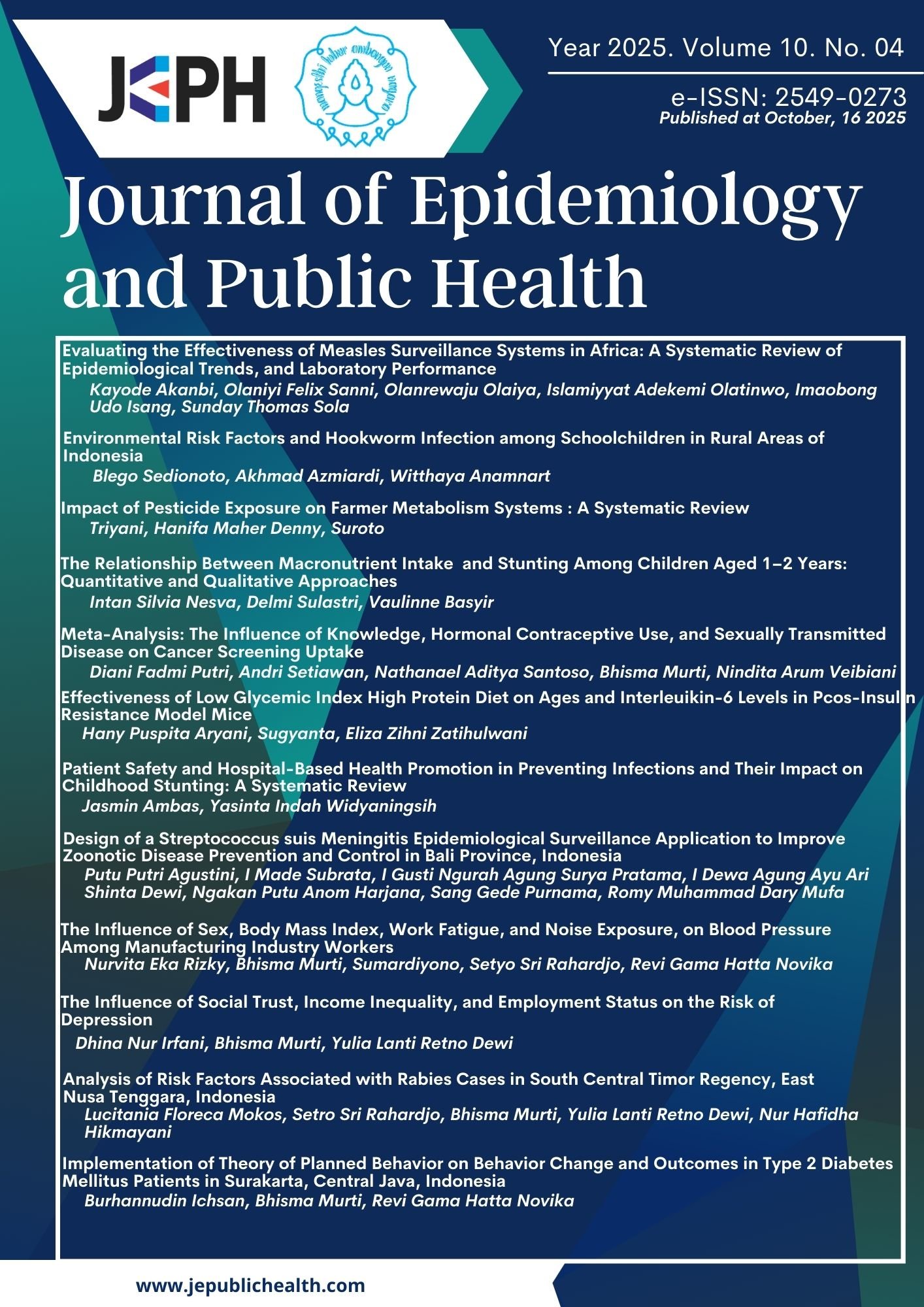
How to Cite
References
Anamnart W, Intapan PM, Pattanawongsa A, Chamavit P, Kaewsawat S, Maleewong W (2015). Effect of dilution of stool soluble component on growth and development of Strongyloides stercoralis. Sci Rep. 5:10749. doi:10.1038/srep10749.
Anamnart W, Pattanawongsa A, Intapan PM, Maleewong W (2010). Albendazole stimulates the excretion of Strongyloides stercoralis larvae in stool specimens and enhances sensitivity for diagnosis of strongyloidiasis. J Clin Microbiol. 48(11):4216–4220. doi:10.1128/JCM.00852-10.
Anamnart W, Pattanawongsa A, Intapan PM, Morakote N, Janwan P, Maleewong W (2013). Detrimental effect of water submersion of stools on development of Strongyloides stercoralis. PLoS One. 8(12):e82339.
Bannon JP, Fater M, Solit R (1995). Intestinal ileus secondary to Strongyloides stercoralis infection: case report and review. Am Surg. 61:377–380.
Bethony J, Brooker S, Albonico M, Geiger SM, Loukas A, Diemert D, Hotez PJ (2006). Soil-transmitted helminth infections: ascariasis, trichuriasis, and hookworm. Lancet. 367:1521–1532.
Daniel WW (2010). Biostatistics: A Foundation for Analysis in the Health Sciences. 10th ed. New Jersey: John Wiley and Sons.
Forrer A, Khieu V, Schar F, Vounatsau P, Chammartin F, Marti H, Muth S, et al. (2018). Strongyloides stercoralis and hookworm co-infection: spatial distribution and determinants in Preah Vihear province Cambodia. Parasit Vectors. 11(33):1–13.
Forrer A, Khieu V, Schindler C, Schar F, Marti H, Char MC, Muth S, et al. (2016). Ivermectin treatment and sanitation effectively reduce Strongyloides stercoralis infection risk in rural communities in Cambodia. PLoS Negl Trop Dis. 10(8):e0004909.
Garcia L (2007). Diagnostic Medical Parasitology. 5th ed. Washington DC: ASM Press.
Hall A, Conway DJ, Anwar KS, Rahman ML (1994). Strongyloides stercoralis in an urban slum community in Bangladesh: factors independently associated with infection. Trans R Soc Trop Med Hyg. 88(5):527–530.
Jongwutiwes S, Charoenkorn M, Sitthichareonchai P, Akaraborvorn P, Putaporntip C (1999). Increased sensitivity of routine lab detection of Strongyloides stercoralis and hookworm by agar-plate culture. Trans R Soc Trop Med Hyg. 93(4):398–400.
Katz N, Chaves A, Pellegrino J (1972). A simple device for quantitative stool thick-smear technique in schistosomiasis mansoni. Rev Inst Med Trop Sao Paulo. 14:397–400.
Khieu V, Schär F, Marti H, Bless PJ, Char MC, Muth S, Odermatt P (2014). Prevalence and risk factors of Strongyloides stercoralis in Takeo province Cambodia. Parasit Vectors. 7(221):1–5.
Khieu V, Schär F, Marti H, Sayasone S, Duong S, Muth S, Odermatt P (2013). Diagnosis treatment and risk factors of Strongyloides stercoralis in school-children in Cambodia. PLoS Negl Trop Dis. 7:e2035.
Koga K, Kasuya S, Khamboonruang C, Sukhavat K, Ieda M, Takatsuka N, Kita K, et al. (1991). A modified agar plate method for detection of Strongyloides stercoralis. Am J Trop Med Hyg. 45:518–521.
Damanik M, Soeyoko S, Sutomo AH (2014). Sanitation of house and school personal hygiene and infection of soil transmitted helminths among elementary school students. Int J Public Health Sci. 3(1):43–49. doi:10.11591/ijphs.v3i1.463.
Na-Ek P, Sanpool O, Jongthawin J, Anamnart W, Intapan PM, Chamavit P, Maleewong W (2016). Restoration of hookworm egg development after prolonged storage in stool suspension. Parasitol Res. 115:2817–2828.
Nery SV, McCarthy JS, Traub R, Andrews RM, Black J, Gray D, Weking EW, et al. (2015). A cluster-randomized controlled trial integrating community-based WASH and albendazole to reduce intestinal parasites in Timor-Leste. BMJ Open. 5(12):e009293.
Pullan RL, Smith JL, Jasrasaria R, Brooker SJ (2014). Global numbers of infection and disease burden of soil-transmitted helminth infections in 2010. Parasit Vectors. 7(37):1–19.
Schär F, Inpankaew T, Traub RJ, Khieu V, Dalsgaard A, Chimnoi W, Odermatt P (2014). The prevalence and diversity of intestinal parasites in humans and domestic animals in a rural Cambodian village. Parasitol Int. 63(4):597–603.
Sedionoto B, Anamnart W (2018). Prevalence of hookworm infection and strongyloidiasis in cats and potential risk factor for human disease. E3S Web Conf. 31:1–5.
Sedionoto B, Wesisombat S, Punsawad C, Anamnart W (2019). Environmental factors and prevalence of hookworm infection and strongyloidiasis in rural East Kalimantan Indonesia. E3S Web Conf. 124:04001. doi:10.1051/e3sconf/201912504001.
Sedionoto B, Wesisombat S, Punsawad C, Anamnart W (2021). The quality of soil and high prevalence of hookworm infection in Muara Kaman and Marangkayu districts Indonesia. Ann Trop Med Public Health. 24(1):1–10. doi:10.36295/ASRO.2021.24135.
Steinmann P, Yap P, Utzinger J, Du ZW, Jiang JY, Zhou XN (2015). Control of soil-transmitted helminthiasis in Yunnan province China: lessons from a 5-year trial. Acta Trop. 141:271–280.
Strkolcova G, Goldova M, Bockova F, Mojzisova J (2017). The roundworm Strongyloides stercoralis in children, dogs, and soil inside and outside a segregated settlement in Eastern Slovakia: frequent but hardly detectable parasite. Parasitol Res. doi:10.1007/s00436-016-5362-1.
Vonghachack Y, Sayasone S, Bouakhasith D, Taisayavong K, Akkavong K, Odermatt P (2015). Epidemiology of Strongyloides stercoralis on Mekong Islands in southern Laos. Acta Trop. 141:289–294.
WHO (2011). Helminth Control in School-age Children: A Guide for Managers of Control Programs. 2nd ed. Geneva: World Health Organization.